Apple Stock Before iPhone 18 Pro: Is AAPL Pricing In a Foldable Supercycle?
Apple is entering its most important hardware launch in years with exceptional fundamentals—and a valuation that leaves little room for an ordinary product cycle. Fiscal Q3 revenue rose 16% to $109.4 billion, while iPhone sales jumped 22%. Yet at roughly $322, AAPL trades near 36 times FY2026 consensus EPS and close to Wall Street’s average target. My read: the iPhone 18 Pro can protect momentum, but the first foldable iPhone must expand average selling prices and ecosystem spending to create meaningful upside.
Table of Contents
- Apple’s core businesses
- FY2026 financial performance and forecast
- iPhone 18 Pro and foldable catalyst
- Dividend and shareholder returns
- Three-year stock performance after launches
- Valuation, target price, bull and bear cases
- FAQ and disclosure
1. Apple’s Core Businesses: Hardware Feeds the Services Flywheel
Apple is not simply an iPhone vendor. The iPhone remains the customer-acquisition engine, while Mac, iPad, Watch, AirPods and Vision products deepen retention. Services—including the App Store, cloud, advertising, payments, AppleCare and subscriptions—monetize the installed base repeatedly.
That distinction matters. In the first nine months of FY2026, Services revenue grew 14% to $91.7 billion and carried a 76.3% gross margin, versus 39.9% for products. Apple therefore does not need explosive unit growth to compound earnings: a richer Pro mix, more paid services and continued share repurchases can raise profit per share faster than device shipments.
2. FY2026 Consolidated Financials and Revenue Forecast
Apple’s FY2026 Q3 Form 10-Q shows broad operating leverage. The reported 50.1% quarterly gross margin benefited by about two percentage points from tariff refunds, so investors should not treat all of that margin expansion as structural.
| USD billions, except EPS | Q3 FY2026 | Q3 FY2025 | YoY | 9M FY2026 |
|---|---|---|---|---|
| Revenue | $109.4 | $94.0 | +16% | $364.4 |
| Gross profit | $54.8 | $43.7 | +25% | $178.8 |
| Operating income | $35.7 | $28.2 | +27% | $122.4 |
| Net income | $29.8 | $23.4 | +27% | $101.5 |
| Diluted EPS | $2.02 | $1.57 | +29% | $6.88 |
Apple’s reported Q4 revenue range of $111.7-$113.7 billion implies approximately $477.1 billion in FY2026 revenue at the midpoint, up about 14.6% from FY2025. FactSet’s FY2026 EPS consensus is $8.83, rising to $9.52 for FY2027. The earnings trajectory is strong, but a forward P/E near 36 means the market is already paying for durable double-digit execution.
<!– Insert the FY2026 statistics infographic here. –>
3. iPhone 18 Pro and the Foldable: Catalyst, Not Yet Fact
Apple has officially scheduled a September 9 event, but it has not confirmed the product names or specifications. Reuters reports that iPhone 18 Pro models and Apple’s first book-style foldable could debut together; the same reporting warns that engineering-test issues could delay mass production or shipments. Treat every detailed specification and shipment forecast as unconfirmed until Apple announces it.
The strategic logic is compelling. A foldable priced above the Pro Max could lift iPhone average selling prices without requiring mass-market volume. It could also increase engagement with gaming, video, productivity and paid services. Counterpoint expects foldable shipments to grow 21% in 2026 and estimates Apple could capture 25% share in its first year. However, IDC’s latest smartphone outlook expects the overall handset market to contract sharply, showing why premium mix—not industry unit growth—is the central thesis.
The biggest swing factors are hinge reliability, display crease quality, battery life, initial supply and price elasticity. A technically elegant device with constrained availability may boost brand perception before it materially changes revenue.
4. Dividend Policy: Buybacks Matter More Than Yield
Apple’s quarterly dividend is $0.27 per share, or $1.08 annualized. Against FY2026 consensus EPS of $8.83, the forward payout ratio is roughly 12%, and the yield near $322 is only about 0.34%. Apple is an earnings-compounder, not a high-income stock.
Repurchases are the larger return mechanism: Apple bought back $61.8 billion of stock during the first nine months of FY2026. That shrinking share count helps convert 20% nine-month net-income growth into 22% diluted-EPS growth.
5. AAPL’s Three-Year Performance Around iPhone Events
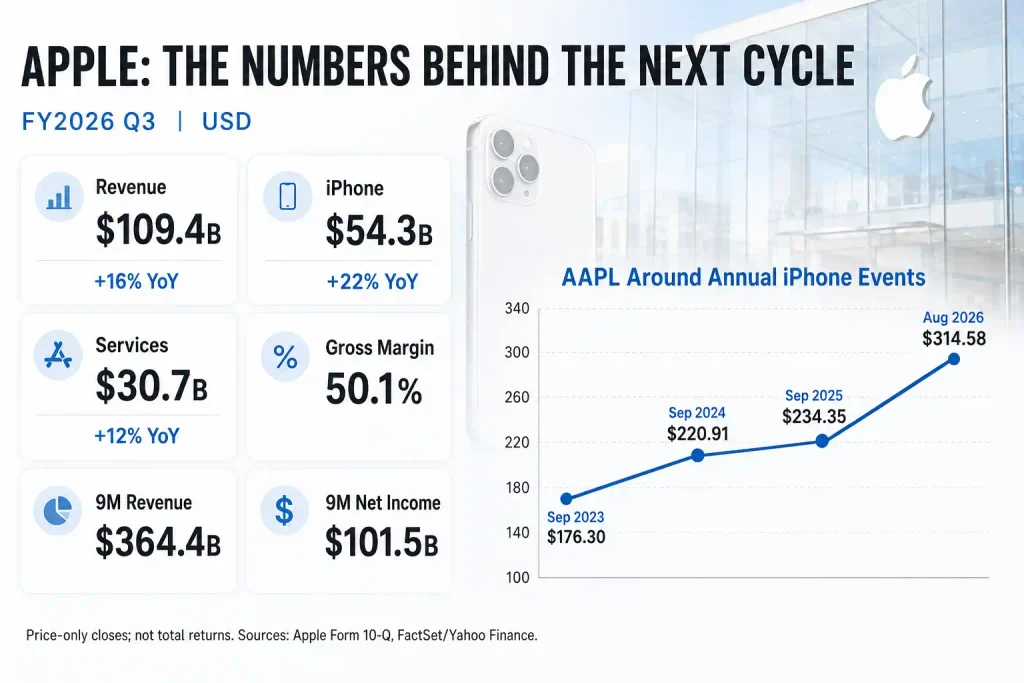
| Reference point | AAPL close | Change from prior point |
| iPhone 15 event — Sep. 12, 2023 | $176.30 | — |
| iPhone 16 event — Sep. 9, 2024 | $220.91 | +25.3% |
| iPhone 17 event — Sep. 9, 2025 | $234.35 | +6.1% |
| Pre-2026 event — Aug. 27, 2026 | $314.58 | +34.2% |
The price rose about 78% from the 2023 event close to August 27, 2026, excluding dividends. But this does not prove that launches caused the return. Earnings, rates, buybacks, AI expectations and market multiples mattered more than the announcement-day reaction. Historically, Apple events often produce short-term “sell the news” volatility; the investable signal is subsequent demand and margin data.
6. Target Price and Investment Verdict
FactSet’s current Wall Street range is $245-$400, with a $333.10 average and $340 median. The average offers only about 3.5% upside from roughly $322.
- Bull case: the foldable establishes a new ultra-premium tier, Services stays near mid-teens growth, AI improves upgrades and buybacks sustain double-digit EPS growth.
- Bear case: foldable shipments slip, tariff benefits reverse, memory costs pressure margins, China competition intensifies and a high earnings multiple compresses.
- Verdict: Hold / accumulate on material pullbacks. Apple remains a world-class compounder, but the current price already discounts much of the FY2026 strength. I would not chase a launch-day spike without evidence of strong preorders, favorable product mix and durable post-refund margins.
FAQ
Is Apple stock a buy before the iPhone 18 event?
The risk-reward is balanced. Fundamentals are strong, but the stock trades close to the average analyst target. Staged buying is more disciplined than betting on one event.
Will a foldable iPhone materially change FY2026 revenue?
Probably not by itself. A late-fiscal-year launch and supply constraints limit near-term contribution. The larger opportunity is FY2027 pricing, mix and ecosystem spending.
Is Apple a good dividend stock?
It offers reliable dividend growth, but the low yield and roughly 12% payout ratio make buybacks and EPS growth more important than income.
What should investors watch next?
Preorder lead times, Pro/foldable mix, Greater China demand, Services growth, normalized gross margin and FY2027 EPS revisions.
Important Disclosure
This article is for general informational and educational purposes only and is not individualized investment, legal or tax advice, an offer, or a solicitation to buy or sell securities. Forecasts, analyst targets and product reports are uncertain and may change. Past performance does not guarantee future results. Investors should verify current filings and consider their objectives, time horizon and risk tolerance before acting.
Publisher conflict disclosure—complete before posting: “As of publication, the author does not own Apple (AAPL) securities and has no other material financial relationship with Apple.